


Get more SRE work done with Team Agents
Team Agents are AI SRE agents that take on the whole SRE job, not just incident resolution. Give Team Agents goals and they work in the background: checking releases, investigating alerts, and remembering what they learn.
Why you’ll love Honeycomb Team Agents
Built on best‑in‑class tracing
Better data in, better answers out. Team Agents start from rich, high-cardinality, full-context traces and query them fast enough to keep asking until they find the answer, not just an answer.
Proactive, between incidents
Team Agents work on the goals and schedules you set, not only when an alert fires. They check releases, watch cost, and improve instrumentation so there are fewer fires to fight.
Powered by shared learnings
Honeycomb's playbook on day one, a decade of observability and SRE practice built in. Then team memory tracks what broke, how often, and whether the fix held, so your team only has to learn something once.
Most teams never get
to what SRE promises
Reliable systems, fewer outages, teams that own their services. In practice, SREs are buried in fire fights, teaching SRE practice to every team takes forever, and AI has cranked the rate of change to eleven. The first wave of "AI SRE" didn't fix it: it wakes up when an alert fires, works every investigation cold, and reasons over fragmented logs and metrics which lack the full context. That's how you get answers that might not be based on all the data. It’s hard to trust AI with real work if it has to guess.
Teams deserve better. Here's what AI SRE done right looks like.
Work towards goals you define
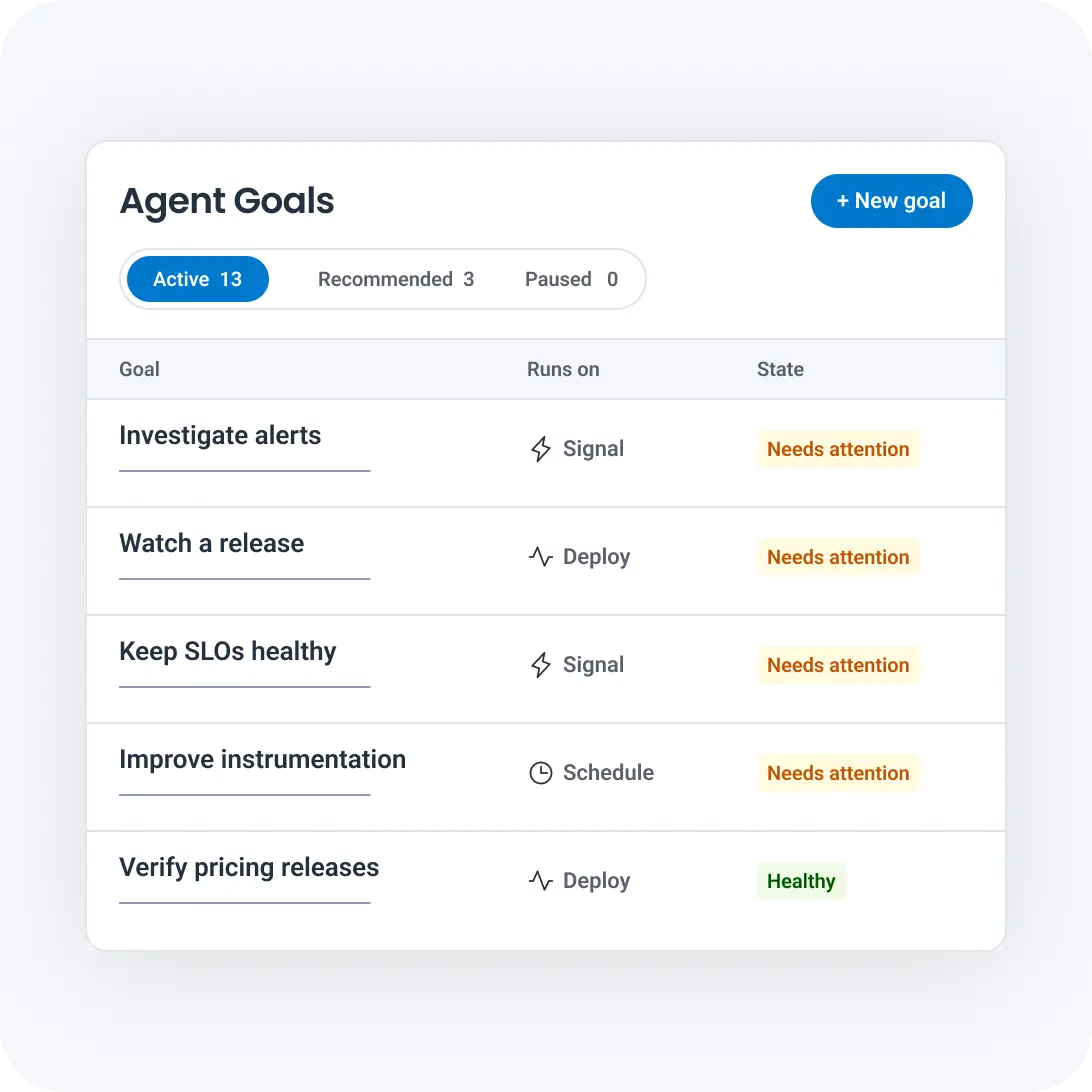
A goal is a job your team hands to Honeycomb Team Agents. You set the scope: a service, an SLO, a dataset, a release, or an AI agent, plus anything to ignore. The goal says when to start and what done looks like, so done is measurable: the SLO holds, the gap is closed, the release is clean.
Build memories and recommend new goals
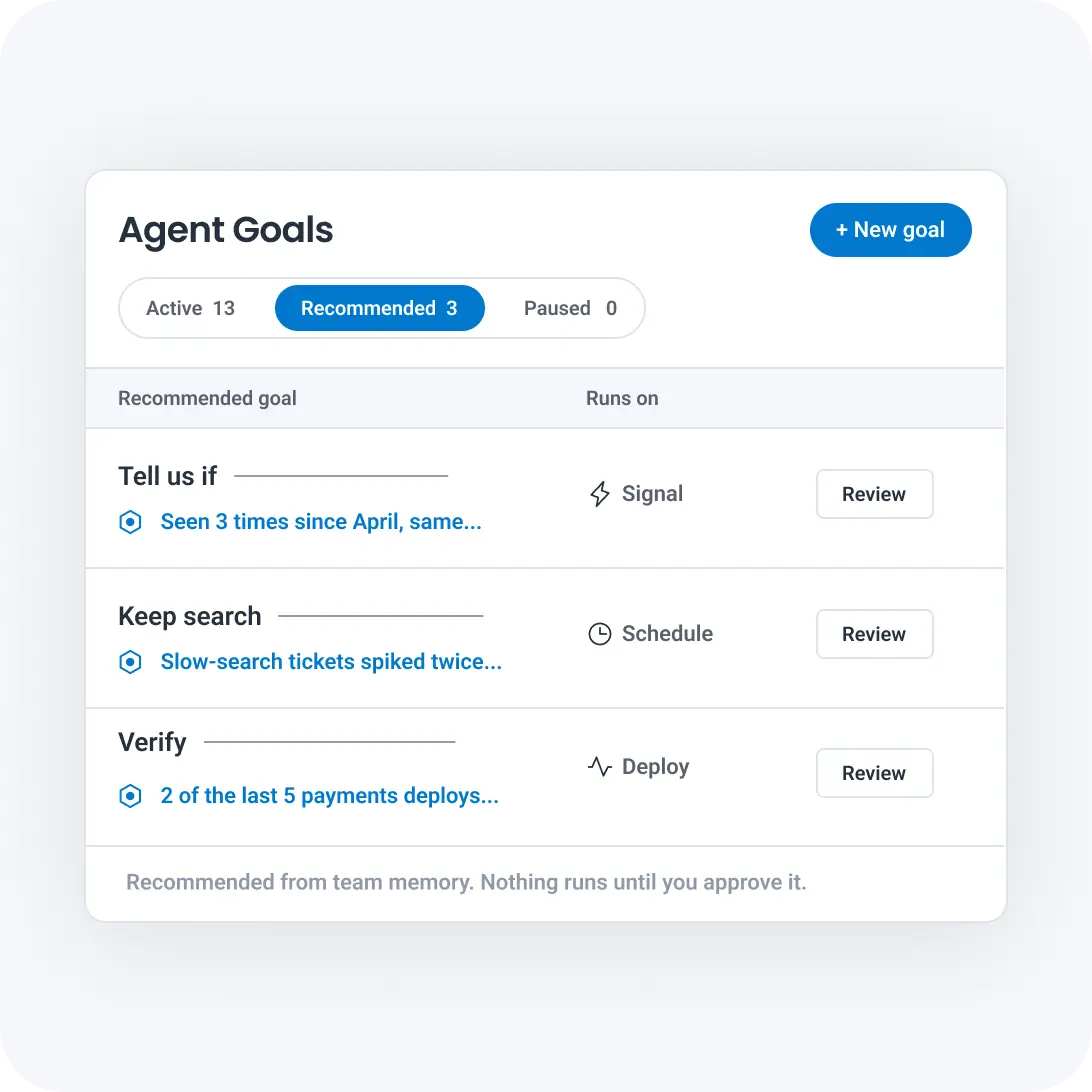
With every investigation, Team Agents learn something. Team Agent Memories track what broke, how often, and whether the fix held, and every entry shows where it came from so anyone on the team can correct it. As that memory grows, Team Agents spot patterns worth watching, like a Redis issue that keeps coming back, and recommend new goals for you to approve.
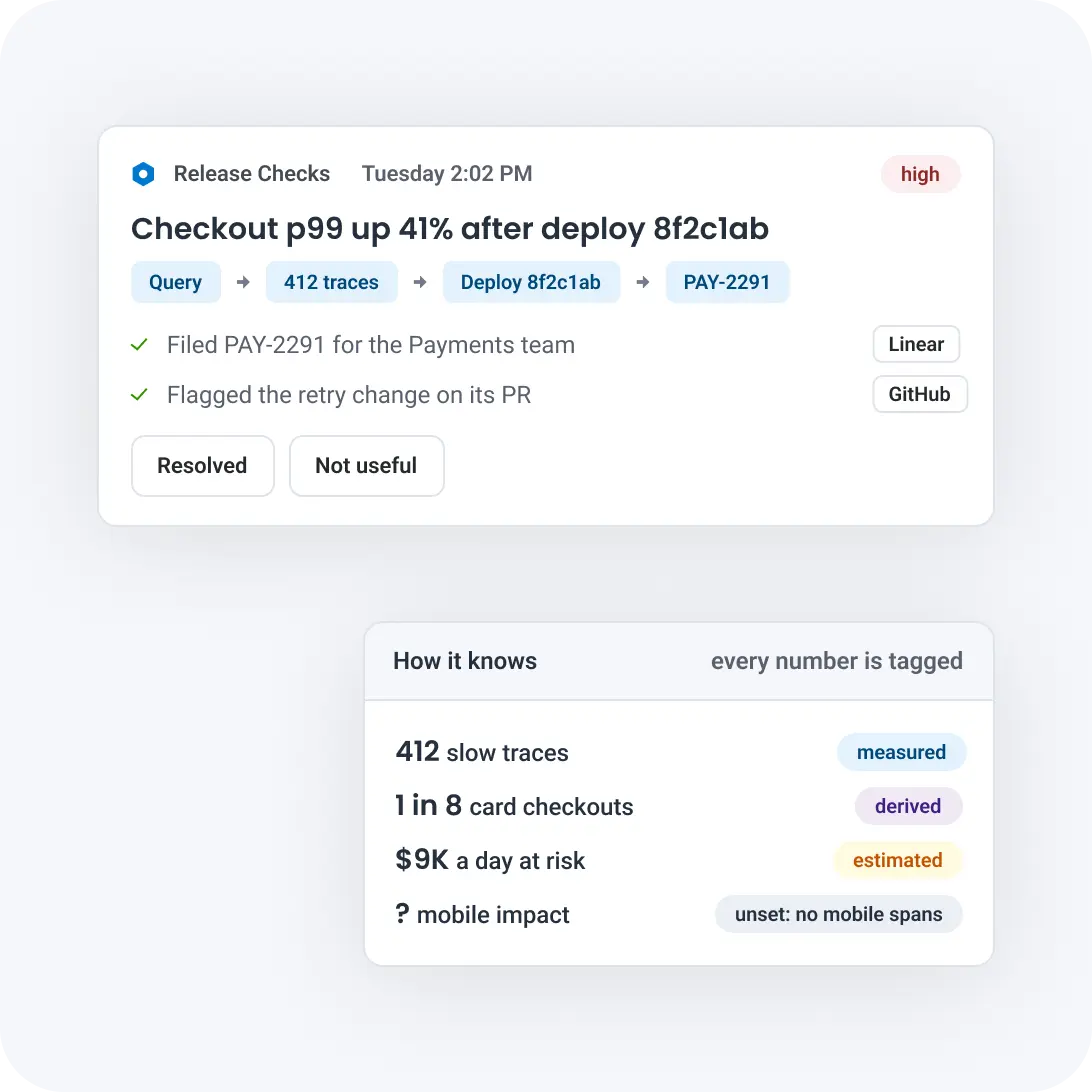
Deliver results through findings
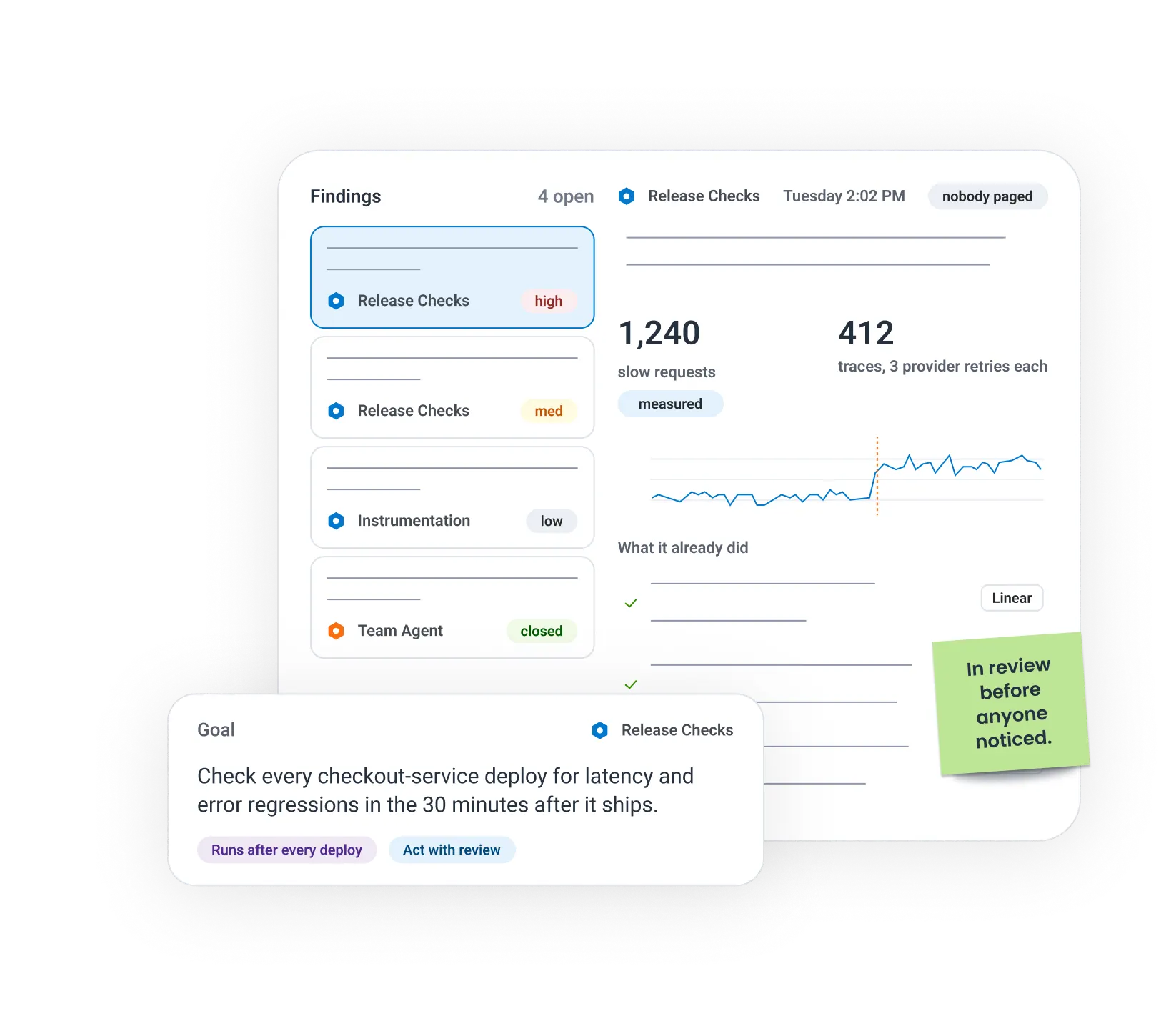
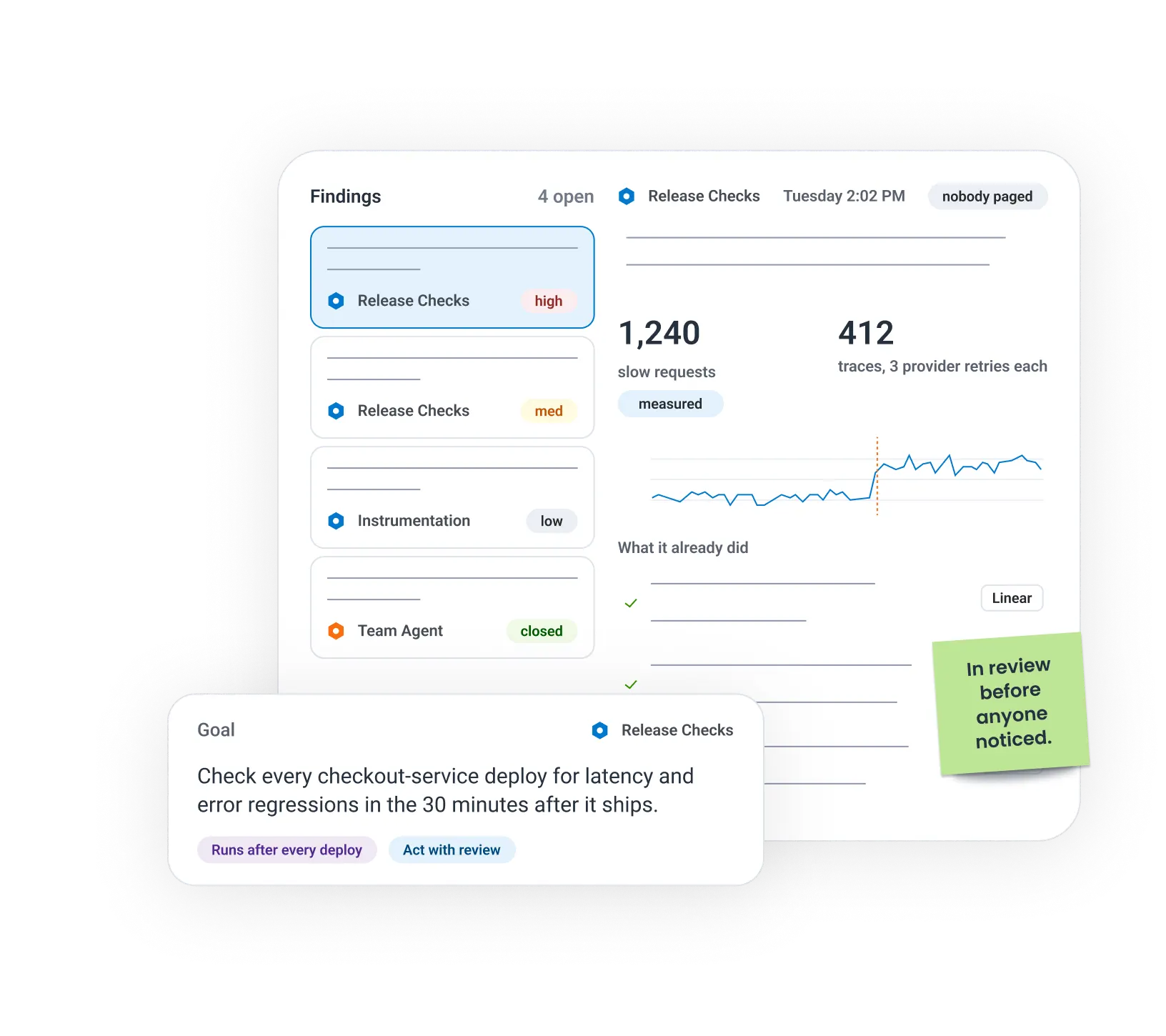
Every finding does two jobs. It shows what's true, with every claim one click from the query, trace, or deploy behind it, and every number tagged with how it knows. And it moves the work forward. Sometimes the finding is "we checked, it's nothing," which is its own kind of peace of mind.
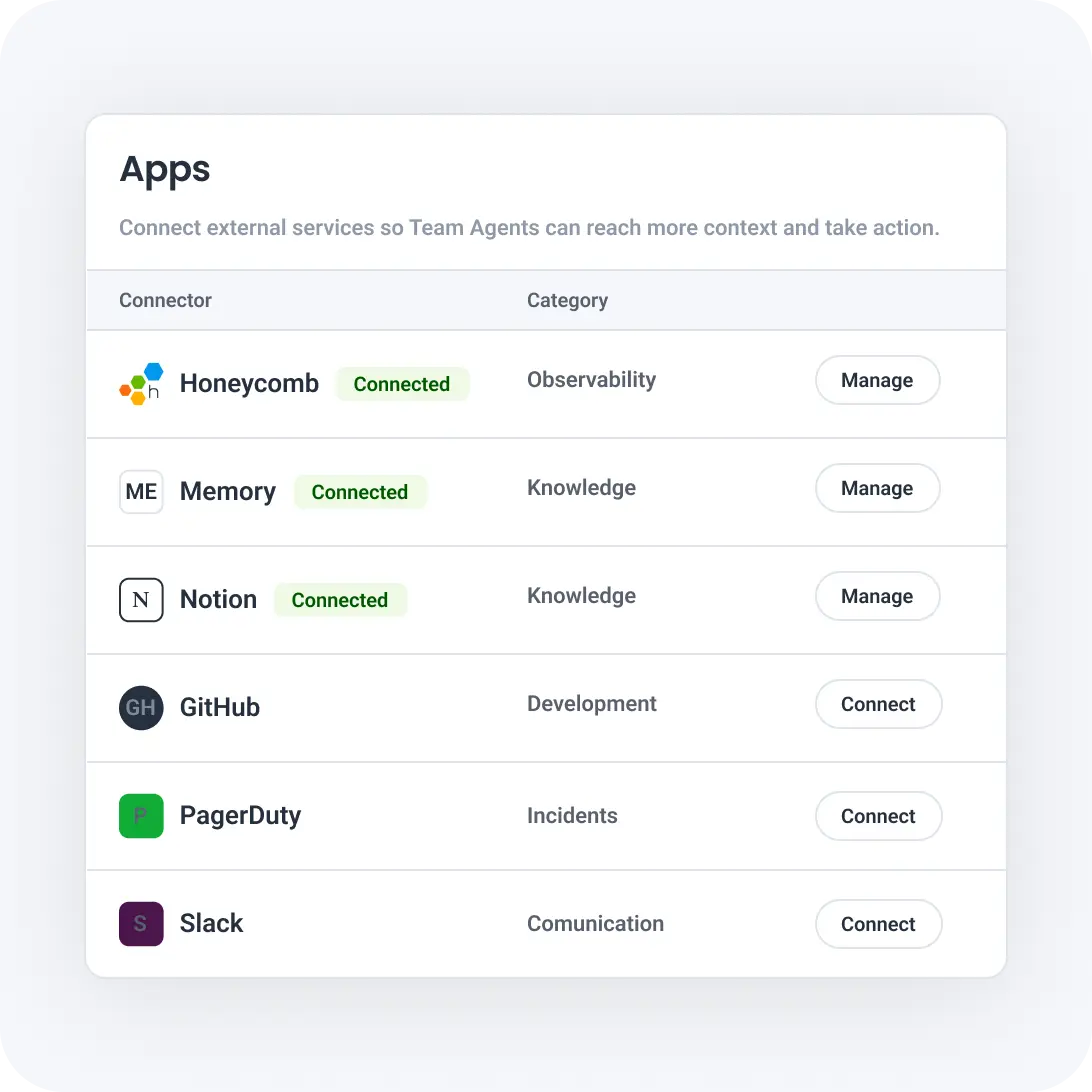
Access context and automation via connectors
Team Agents use connectors to read evidence and optionally do work in the tools you already use, like GitHub, LaunchDarkly, and Braintrust. They turn findings into finished work: the ticket filed, the responder paged, the fix drafted. You set how much they can do on their own, per goal and per action.
AI SRE agents that go beyond incidents
Real SRE work isn't just incident response. It's checking releases, keeping instrumentation honest, watching cost, keeping runbooks current, and making sure the AI features you shipped last month still behave. Here are six example goals that teams can hand to Team Agents.
Verify checkout releases
Check every checkout-service deploy for latency and error regressions in the 30 minutes after it ships.
Improve agent quality
Compare Braintrust eval scores with live conversation traces after every prompt or model change.
Flag Lambda spend
Protect your margins by flagging Lambda spend that threatens your margin SLO.
Investigate alerts
Pick up triggers and burn alerts, recommend remediation, open the incident channel, and page a responder.
Improve instrumentation
Review your Honeycomb datasets and recommend instrumentation improvements, filed in Linear.
Maintain the knowledge doc
Review findings and Slack threads, then draft updates to your Notion or Confluence docs.
Team Agent sounds like the future: your observability platform is going to do this for you. I can set up my crons or my triggers right there.

Daniel Worku
Co-founder and CTO, StarSling
The second edition is here! Get your copy today
AI is changing the nature of software development. Observability is how you navigate this shift. Charity Majors, Liz Fong-Jones, George Miranda, and Austin Parker explain the core principles of observability and how to leverage it for your organization.
- Download your free copy of the book
- Get a preview of what you’ll learn
- Get access to 27 new chapters in over 600 pages

Related features
Want to know more?
Talk to our team to arrange a custom demo or for help finding the right plan.