Honeycomb was built for the AI era. Learn how to futureproof your software for what comes next.
Discover why Honeycomb is the better choice for your engineers, your customers, and your bottom line.
Start your journey with the definitive guide to observability. Download our complimentary ebook.
Bring observability to every software engineer.
Learn about our company, mission and values.
Come for the impact, stay for the culture.
See Honeycomb's latest press releases, media, and more
Learn more about becoming a Honeycomb partner.
Already a Honeycomb customer?
Fred Hebert
I anticipated this would be a challenging time and that I would be exhausted. So, the plan became: do all the demanding things, take my sabbatical in May, and use April as an ‘in-between’ period with a bit less pressure. I would willingly step off the gas and let other SREs on the team cover pressing matters, as a sort of pre-game for my full month away.
Mike Terhar
There are many vendors, Honeycomb included, where actions on the application can emit a web request that goes to another service for coordination or tracking purposes. Many vendors have pre-built integrations, but some have a fallback that says “Custom Webhook” or similar. If you’re looking to create a full picture of your request flow, you would want these other services to show up in your trace waterfall.
Ken Rimple
I want to know what users are doing in my application. A distributed trace is the best way to show the data flow of one user interaction through my application, but it isn’t sufficient to show the overall user experience.
Martin Holman
The HTTP Content-Security-Policy response header is used to control how the browser is allowed to load various content types. It is used to control which URLs, fonts, images, scripts, and more can be loaded…
Rox Williams
Kubernetes is widely used for deploying, scaling, and managing systems and applications and is an industry standard for container orchestration. Google engineers originally developed Kubernetes as an open-source project. Its first release was in September 2014, and since then, it has matured into a graduate project maintained by the Cloud Native Computing Foundation (CNCF). With the complexities of scale and distributed systems, debugging in Kubernetes environments can be difficult.
Martin Thwaites
In this post, I’ll cover what synthetic monitoring is and show an example of how you can create a simple monitor using OpenTelemetry, .NET, and an Azure function. If you only want to see how it’s built, skip ahead to building a synthetic monitor.
Charity Majors
In last week’s piece, we talked about some of the factors that are driving costs up, both good and bad, and about whether your observability bill is (or should be) more of a cost center or an investment. In this piece, I’m going to talk more in depth about cost drivers and levers of control.
The session.id field is special in Honeycomb for Frontend Observability. It’s a default option for filtering and grouping, and it’s the basis for session timeline analysis (in Early Access). Now you can control how session.id is set.
Irving Popovetsky
The idea that telemetry data needs to be managed, or needs a strategy, draws a lot of inspiration from the data world (as in, BI and Data Engineering). Your company most likely has a data team that manages the data warehouse(s), data pipelines, data sources, and reporting tools. These teams are also constantly balancing costs with their user and stakeholder needs, usability, data retention, granularity, etc. Sound familiar? That’s because if you’re working on observability data, these teams are at least several years ahead of you in addressing these tradeoffs and considerations—and can teach us quite a lot.
In 2018, I dashed off a punchy little blog post in which I observed that teams with good observability seemed to spend around ~20-30% of their infra bill to get it. I also noted this was based on absolutely no data, only my own experiences and a bunch of anecdotes, heavily weighted towards startups and the mid-market tech sector.
Austin Parker
Seems like you can’t throw a rock without hitting an announcement about a Model Context Protocol server release from your favorite application or developer tool. While I could just write a couple hundred words about the Honeycomb MCP server, I’d rather walk you through the experience of building it, some of the challenges and successes we’ve seen while building and using it, and talk through what’s next. It should be pretty exciting, so strap in!
Christine Yen
We’re excited to share that Honeycomb has completed our first-ever acquisition: we’re joining forces with Grit, bringing aboard not only a strong team but also compelling technology that supercharges our ability to deliver on our mission: to bring observability to every software engineer.
Get it delivered straight to your inbox.
By subscribing to our newsletter, you agree to Honeycomb’s Terms of Service and Privacy Notice.
Observability is way more about software engineering than it is about operations. Operators are users of observability data for monitoring and alerting on systems. They’ll use that telemetry data to scale systems, or potentially debug the outside of applications. In contrast, software engineers are creators, designers, and users of observability data, and where they use that data is much wider than that of pure operators of production systems.
You can’t throw a rock without hitting an online discussion about ‘vibe coding,’ so I figured I’d add some signal to the noise and discuss how I’ve been using AI-driven coding tools with observability platforms like Honeycomb over the past six months. This isn’t an exhaustive guide, and not everything I say is going to be useful to everyone—but hopefully it will clear up some common misconceptions and help folks out.
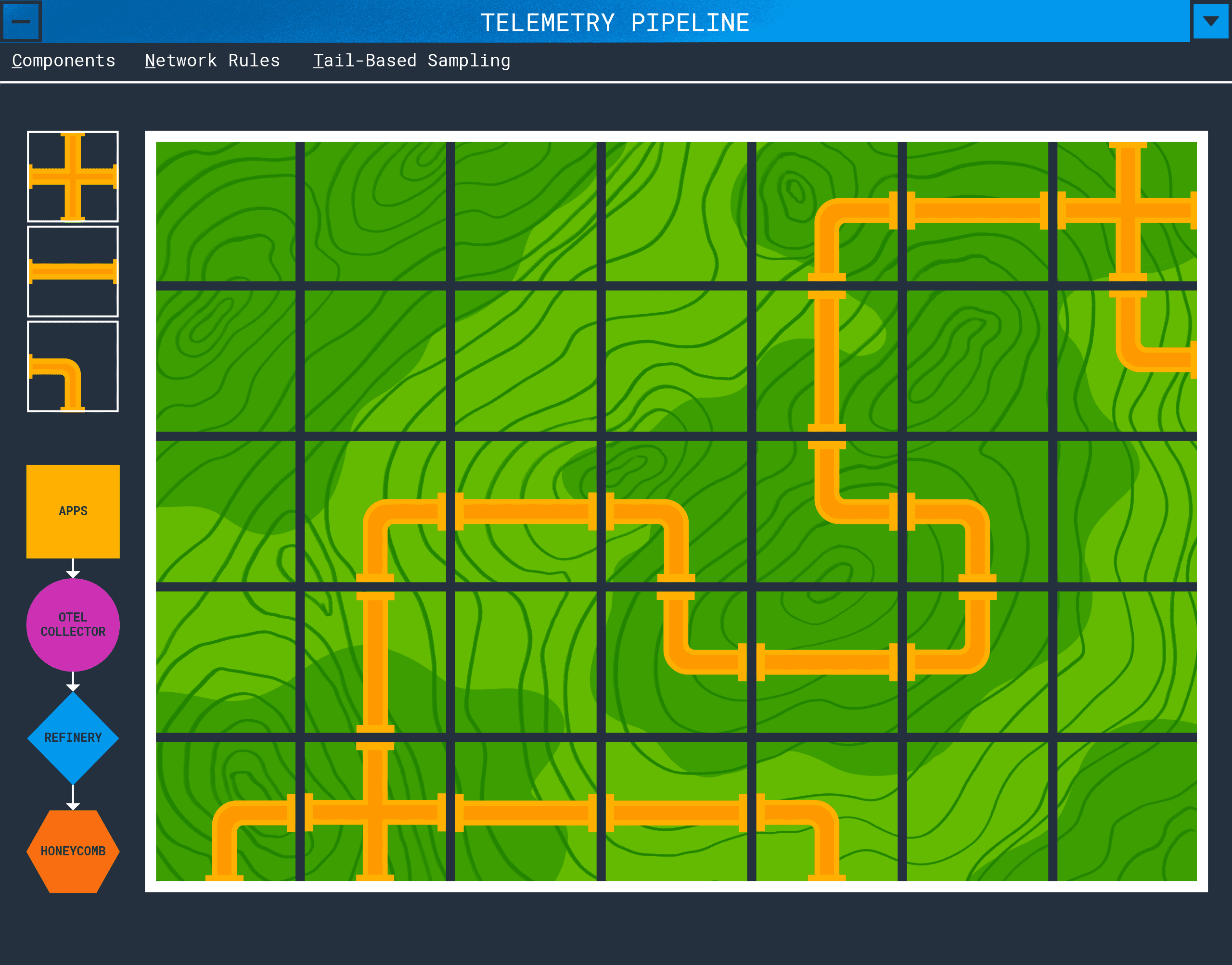
In a simple deployment, an application will emit spans, metrics, and logs which will be sent to api.honeycomb.io and show up in charts. This works for small projects and organizations that do not control outbound access from their servers. If your organization has more components, network rules, or requires tail-based sampling, you’ll need to create a telemetry pipeline.
David Marchante
At Honeycomb, we believe that observability should be accessible, effective, and transformative. That’s why our customer education team is thrilled to introduce Honeycomb Academy, a learning hub designed to help our customers of all experience levels master observability, OpenTelemetry, and the Honeycomb platform.
Grady Salzman
At Honeycomb, we’re actively growing our design system, Lattice, to ensure accessibility, optimize performance, and establish consistent design patterns across our product. One metric we use to measure Lattice is the adoption of components across the product. Adoption is about understanding how, where, and why they’re being used.
Davin Taddeo
CloudWatch metrics can be a very useful source of information for a number of AWS services that don’t produce telemetry as well as instrumented code. There are also a number of useful metrics for non-web-request based functions, like metrics on concurrent database requests. We use them at Honeycomb to get statistics on load balancers and RDS instances. The Amazon Data Firehose is able to export directly to Honeycomb as well, which makes getting the data into Honeycomb straightforward.
How many of you started with technologies you still use exactly the same way today? Even if you’re a master Lisp/Clojure developer, you’ve still evolved, right? I should really get my head around those parentheses some day.
Kate Guarente-Smith
Last week marked the inaugural HumanX conference, a convening of leaders, technologists, policy makers, and media, all brought together to discuss the state of AI and its potential impact on the future of software, business, and society.